
The granddaddy of social media may be on its deathbed.
As Facebook struggles to keep up with the fast and hip social-media platforms of today, analysts say that the giant is nearing the end of its lifecycle. Recent policy updates have only sped up the process. However, Facebook as a company, with all its young subsidiaries, is still miles ahead of the competition.
With roughly 2.8 billion monthly active users reported in the fourth quarter of 2020, Facebook is still the biggest social networking website in the world. However, it saw a decline in daily and monthly active users in the United States and Canada in the second half of 2020. More importantly, there has been a sharp decline in younger users in recent years.
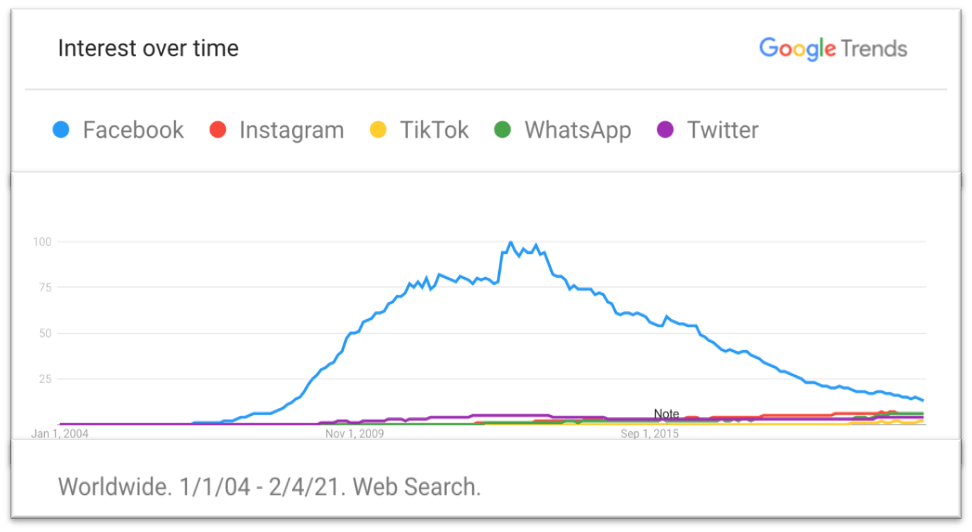
“The younger generation sees Facebook as a place where their parents and grandparents keep in touch with other ‘older’ people,” explains Dr. Jocelyn DeGroot, Professor of Applied Communication Studies at Southern Illinois University. “They might have an account simply to have one, but they aren’t as active on Facebook as they are on other social media accounts.”
This is backed up by a 2018 report from Pew Research Center which states that 51% of U.S. teens used Facebook. This number fell from 71% in the 2014-15 survey. During this time, Instagram saw a 20% increase to 72% in 2018. Only 10% of the survey respondents said that they use Facebook as their primary social media network.
This trend of social-media users preferring Instagram over Facebook can be seen in other external reports as well. “Instagram’s dominance over Facebook continues to expand at an accelerated pace,” reported Socialbakers, an AI-powered social media marketing company, in its Q4 2020 Social Media Trends report. “Instagram’s audience grew by 11.3% while Facebook’s audience size dropped by 17.6% year-over-year in Q4 2020.” Socialbakers further reported that Instagram had 21 times more interactions between users than Facebook.
“It all comes back to if Facebook continues to modify itself to meet the needs of the consumer.”
Dr. Jocelyn DeGroot
A portion of this trend is the result of young people’s shift in demands from a social platform. “It seems that the upcoming generation (I’m thinking of 13-19-year-olds) prefer ‘blurbs’ of information,” Dr. DeGroot says. “They want quick videos, short and fleeting messages, etc. This is why TikTok, Instagram, SnapChat, WhatsApp, and others are used more often by that demographic.”
While the successes and failures of a platform can be attributed to its design, audience needs, and external factors, according to Dr. Venus Jin, Professor of Digital Media Studies at Northwestern University in Qatar, “organic reasons include the increased distrust of Facebook due to privacy concerns.” She also points towards general disinterest in Facebook being another leading cause for the decline in user activity on the platform.
Dr. DeGroot believes that privacy and data policy concerns are a major reason why young people avoid Facebook. “Younger generations don’t appear to be too impressed with Zuckerberg and how Facebook contributed to some confusion, misinformation, and other negative aspects of the 2016 US Presidential Election,” she says. “They are much more politically aware and have a strong sense of social responsibility. If a platform is amazing and meets all of their practical needs but is socially irresponsible, they won’t use it.”
Both Dr. Jin and Dr. DeGroot believe that social media platforms have a life cycle. To keep up, Facebook must keep changing and evolving. “It all comes back to if Facebook continues to modify itself to meet the needs of the consumer,” Dr. DeGroot says. “The younger generations have different needs and different skills than older generations.”
Scott Fulton, an information technology journalist at ZDNet, has a different perspective. “We need to ask ourselves what it is we truly want social media to provide us with,” he says. “If it truly is visibility and global connectivity, then rather than “evolve” the Facebook platform, we should explore a completely new model of communication and facilitation for this service where the tired old web is not the go-between.”
Social media trends, like all other technologies, continue to change based on what the requirements of the end-user are. However, as technology reaches the end of its life cycle, it may not be able to evolve further or keep up with changing needs. “We tend to write about the fast pace of technological evolution. The truth is, that’s all baloney,” Fulton says. “Society, and certain aspects of society, can evolve and get smarter more quickly; Facebook’s progress lags behind ours.”
In any case, while Facebook as a platform may have reached its demise, its daughter companies like Instagram and WhatsApp are taking its place. “Facebook as a company may very well flourish,” says Fulton. “It has become a major owner of fiber optic communications lines – first trans-oceanic, and now terrestrial.”
Dr. Jin also has faith in Facebook’s survival as a company. She believes that while the platform is seeing a decline in users, the company, with its subsidiaries like Whatsapp, Oculus VR and LiveRail, is still growing.

 Abdullah Imran Tahir